








You’re lying on your couch at 11pm, scrolling through furniture websites, trying to figure out whether that gorgeous mid-century modern sofa will actually fit in your living room without making it look like a furniture warehouse. You open your measuring tape app, squint at the ceiling, and ultimately just… guess. You buy it. It arrives two weeks later, and it’s roughly the size of a small aircraft carrier. Sound familiar?
That painful experience and the expensive return that followed are exactly the problem augmented reality is solving right now, today, in ways that are more sophisticated than most shoppers realize. AR in e-commerce isn’t a future promise anymore. It’s a present reality reshaping how billions of dollars worth of goods are bought and sold every single year. IKEA, Sephora, Nike, and Warby Parker—these aren’t fringe tech experimenters. They’re mainstream retailers who have quietly made AR a core pillar of their shopping experience.
The numbers back this up hard. According to a 2023 Shopify report, products with AR experiences see a 94% higher conversion rate compared to those without. Let that sink in. Nearly double the conversions, simply by letting people see before they buy. And Snap Inc.’s research found that 93% of consumers expect AR to be part of their shopping experience in the near future. We are at an inflection point.
So what’s actually happening under the hood? Why does AR work so well for e-commerce, and where is it heading next? Buckle up, because the intersection of pixels and physical space is more interesting than you might think.
Why AR Solves the Fundamental Trust Problem in Online Shopping

The “Imagination Gap” That Kills Conversions
Here’s the dirty secret of e-commerce that every product manager knows but rarely talks about openly: we ask customers to make purchasing decisions based almost entirely on imagination. You see a flat photograph, read some bullet points about dimensions, maybe watch a 30-second video, and then you’re expected to confidently hand over $400 for something you’ve never touched, sat on, worn, or held in your hands.
Cognitive scientists call this the “mental simulation gap.” Our brains are remarkably bad at accurately projecting how a three-dimensional object will look in a specific real-world context from a two-dimensional image. We can approximate, but we consistently get it wrong. A color that looks perfect on screen looks completely different under your apartment’s warm tungsten lighting. A jacket that looks relaxed on a 6’2″ model looks entirely different on a 5’7″ frame. The gap between expectation and reality is where returns are born.
AR closes this gap with brutal efficiency. When IKEA launched its Place app back in 2017, powered by Apple’s ARKit, it wasn’t just a gimmick. It was the first mainstream attempt to eliminate the imagination gap entirely. Customers could drop a 3D model of a bookshelf into their actual living room and walk around it, crouch down to check clearance, and see how it looked next to their existing furniture. The mental simulation was replaced by an actual simulation. And when simulation replaces imagination, confidence replaces anxiety, and confident customers buy.
The Return Problem Is Really a Trust Problem
Returns cost the U.S. retail industry an estimated $816 billion in 2022, according to the National Retail Federation. A significant chunk of those returns come from the mismatch between expectation and reality—the couch is too big, the lipstick shade is wrong, and the sneakers look nothing like they did on screen. Every return represents a failure of trust, a moment where the customer felt misled, even if unintentionally.
What’s fascinating is that AR doesn’t just reduce returns; it changes the nature of the shopping relationship. When you’ve virtually tried on a pair of glasses using Warby Parker’s app and you genuinely like how they look on your actual face, you’re not just buying glasses. You’re buying with a level of certainty that feels almost like in-store confidence. The trust equation shifts completely. You feel like you made an informed decision, not a gamble.
This psychological shift matters enormously for brand loyalty, not just conversion rates. Customers who feel confident in their purchase decisions tend to become repeat buyers. They associate that feeling of informed confidence with the brand that gave it to them. That’s why the ROI of AR investment in e-commerce extends well beyond the immediate conversion boost; it’s a long-term trust-building mechanism dressed up in very cool technology.
The Real-World Leaders: Who’s Getting AR Right and What We Can Learn

Sephora’s Virtual Artist — A Masterclass in Reducing Friction
Sephora’s Virtual Artist feature is arguably the gold standard of AR in retail, and it’s worth dissecting why it works so well. Launched progressively since 2016, the feature lets users try on thousands of lipstick shades, eyeshadow palettes, blush colors, and more—all in real time on their own face, using just their phone camera. The facial mapping technology tracks micro-movements, adjusts for lighting conditions, and renders products with enough realism that users can genuinely evaluate whether a color works for them.
But here’s what makes Sephora’s implementation exceptional from a UX perspective: it’s seamlessly integrated into the purchase flow. You’re not bouncing between an AR app and a separate shopping app. Try-on and checkout live in the same ecosystem. You try the lipstick, you like it, you tap once, and it’s in your cart. The friction between discovery and purchase has been reduced to nearly zero. That’s not an accident; that’s deeply intentional product design.
The results are predictably impressive. Sephora reported that customers who used Virtual Artist were 11% more likely to convert than those who didn’t. More tellingly, return rates for products tried virtually were significantly lower. When customers can actually see how a product looks on their specific skin tone in their specific lighting, the guesswork evaporates. This is AR doing exactly what it was designed to do and doing it exceptionally well.
Nike’s Fit Feature and the Size Problem Nobody Talks About Enough
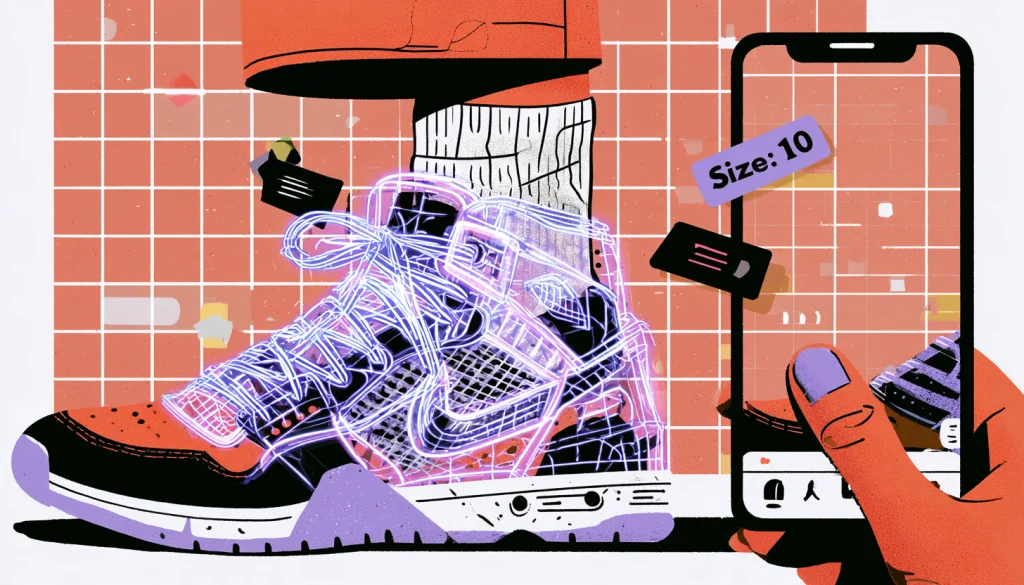
Sizing is one of the most quietly catastrophic problems in fashion e-commerce, and Nike tackled it head-on with their Nike Fit feature. Using a combination of AR and machine learning, Nike Fit scans your foot using your smartphone camera, maps 13 data points, and recommends the precise Nike shoe size for your specific foot shape. Not the size you think you are. Your actual size—for that specific shoe model.
Why does this matter? Because shoe sizing is a wild, inconsistent mess. A size 10 in one Nike model can fit completely differently from a size 10 in another. Different widths, different lasts, different materials. Nike found that 60% of people wear the wrong shoe size, which is a staggering statistic that explains an enormous amount about returns, discomfort, and brand dissatisfaction. Nike Fit doesn’t just improve the shopping experience; it solves a fundamental product-to-customer fit problem.
The broader lesson here for product designers and e-commerce teams is this: the best AR implementations aren’t just cosmetic improvements. They’re solving real, specific, measurable customer pain points. They start with the problem (“customers don’t know their correct size”) and work backward to a technology solution, rather than starting with the technology and searching for a problem to apply it to. That distinction—problem-first versus technology-first thinking—is what separates the AR implementations that actually move metrics from the ones that end up as press release fodder.
The UX Design Principles That Make or Break AR Shopping Experiences
Performance and Realism: The Uncanny Valley of Product Visualization
There’s a concept in robotics and CGI called the uncanny valley, the idea that as artificial representations get almost but not quite realistic, they actually become more unsettling and less trustworthy than obviously artificial ones. AR in e-commerce has its own version of this problem. A 3D product model that renders slowly, clips through surfaces, has inconsistent lighting, or moves unnaturally doesn’t just fail to help; it actively erodes trust. Customers look at a weirdly rendered AR couch floating unconvincingly in their living room and think, “If the company can’t even get this right, can I trust their actual product?”
The technical bar for AR product experiences is therefore higher than it might seem. You need accurate photorealistic rendering that responds correctly to ambient lighting. You need precise surface detection so objects rest naturally on floors and tables rather than floating in mid-air. You need smooth, low-latency performance; even a 200 ms lag between device movement and AR object movement breaks the illusion completely. These aren’t nice-to-have polish items. They’re table stakes for an AR experience that actually builds rather than destroys confidence.
The good news is that the tools available to developers have improved dramatically. Apple’s RealityKit framework, Google’s ARCore, and platforms like Threekit and Vertebrae have made high-quality AR product visualization more accessible to e-commerce teams without massive custom engineering investments. The question for most teams isn’t whether they can achieve good AR quality—it’s whether they’re investing sufficient attention in the quality bar or treating AR as a checkbox feature rather than a genuine experience investment.
Onboarding, Discoverability, and Not Overwhelming Your Users
Here’s a counterintuitive truth about AR features in e-commerce apps: if users don’t know they exist or can’t figure out how to use them in under 10 seconds, they might as well not exist at all. Discoverability and onboarding are the quiet killers of otherwise excellent AR features. You can have the most photorealistic, technically brilliant AR furniture visualization tool in the industry, and if it’s buried three menu levels deep with a confusing icon, your conversion lift will be approximately zero.
The best AR integrations are contextually triggered, they appear exactly when and where they’re most useful, without requiring users to hunt for them. Wayfair places its “View in Room” button directly on product pages, prominently positioned, with a clear visual icon that communicates the functionality instantly. There’s no separate AR section in the app navigation. The feature surfaces at the exact moment of purchase consideration, which is when it provides maximum value.
Onboarding within the AR experience also needs to be minimal and immediate. Users should understand what to do within seconds of launching the AR view, point the camera at the floor, move the phone slowly to detect the surface, tap to place the object. Progressive disclosure works well here: show the essential first step, then surface secondary controls only after the primary interaction is established. Think about it like teaching someone to ride a bike. You don’t explain gear shifting before they can balance. You get them moving first.
Where AR in E-Commerce Is Heading Next
Spatial Commerce and the Apple Vision Pro Moment
The launch of Apple Vision Pro in early 2024 didn’t just introduce a new device. It introduced a new paradigm: spatial commerce. Shopping where your entire environment becomes the store. Where you don’t look at a screen to browse products, you walk among them, in your own space, on your own terms. This isn’t science fiction. It’s happening right now, and the e-commerce teams paying attention to it today will have a significant first-mover advantage.
Several brands, including Mytheresa and e.l.f. Cosmetics, have already launched Vision Pro shopping experiences that let users browse products as three-dimensional objects floating in their physical space. The interaction model is fundamentally different from smartphone AR, instead of pointing a phone camera, you’re navigating a full spatial environment using your eyes and hands. Products can be examined from every angle, sized against your actual environment, and compared side-by-side in three dimensions. It’s the closest thing to physical retail that digital commerce has ever produced.
The implications for product design teams are substantial. Spatial commerce requires rethinking information architecture, interaction design, and even copywriting for an environment where there is no fixed screen size, no scroll behavior, and no traditional navigation. The designers who start experimenting with spatial interaction models now, even without access to widespread user bases, will build the instincts and frameworks that become valuable fast as spatial computing adoption grows.
Personalized AR and the Next Frontier of Individual Fit
The next evolution beyond “try before you buy” is “try customized specifically for you.” Brands are already beginning to combine AR with personalization engines, creating experiences where the product you’re virtually trying on is dynamically adapted to your specific measurements, preferences, and past behavior. Imagine an AR clothing try-on that doesn’t just show you how a jacket looks, it shows you how it looks after it’s been tailored to your exact measurements, in the colorway your purchase history suggests you prefer, styled with items already in your wardrobe.
Companies like Fit:Match are already using 3D body scanning and AI to match customers with clothing that fits their specific body shape, not just their nominal size. When you layer AR visualization on top of that level of personalization, the online shopping experience doesn’t just approximate in-store, in some ways it exceeds it. Your personal shopper at a physical store doesn’t have access to your complete purchase history, your precise measurements, and machine-learning-powered style predictions simultaneously. AR plus personalization creates something genuinely new.
The data implications are significant and worth addressing directly. Personalized AR experiences necessarily collect detailed biometric data, body measurements, facial geometry, foot dimensions. As product designers and e-commerce professionals, we have a responsibility to be transparent with users about what data is being collected, how it’s stored, and what it’s used for. The brands that get this right, that earn trust through transparency, will thrive. The ones that treat biometric data carelessly will face not just regulatory consequences but serious erosion of the customer trust that makes AR valuable in the first place.
AR Is the Present of Shopping, Not the Future
The transformation of e-commerce through augmented reality isn’t a trend to watch, it’s a shift to participate in, right now, with intention and craft. Whether you’re a UX designer building the next great AR try-on experience, a product manager deciding where to invest your team’s roadmap, or a digital retailer trying to close the gap between online browsing and confident purchasing, the message is the same: AR is not the future of shopping. It’s the present of shopping, and the distance between the brands doing it well and the brands ignoring it is growing wider every single quarter. The couch-that-was-too-big story doesn’t have to be anyone’s story anymore.